
No rules match your search.
Game setup
Before any game, it's important to know how to set up an official AFL server. This ensures that the gameplay is played fairly & for a smooth experience. Either a Head Coach or Referee will create the server while adjusting the following settings:
- turn off public listing
- set fumbling chances to 1
- set play clock size to 20
- set quarter length to 4
- turn off pass break up
- turn on trucking
- turn on hitstick
Webhook
This is the most important step, in order to ensure game results & stats are shared with high ranks, referees or head coaches will need to have a webhook attached to their server settings. To get this webhook, you must be a head coach or referee. Receive it by contacting the operations executive team.
Team arrival
Games should start at the scheduled time, however, in the event of a delay, there are time limits to how much longer a delay can be prolonged.
- If Team A has less than 6 players after 10 minutes ahead of the scheduled time, Team B is given the option to either take the forfeit win, or prolong the delay longer to allow Team A more time to get players.
- If Team A & B both have less than 6 players after 10 minutes ahead of the scheduled time, the game will result in a two-way forfeit. Both teams may opt to schedule the game to a later time or day within the current week scheduling deadline.
Both Head coaches must be given admin permissions upon joining. In order to do this, the server owner will use the following command: :padmin [roblox-username]
Start of game
Starting the server
Once both head coaches are ready, the server owner will start the game from Intro. Games have no reason to be starting more than 10 minutes after the scheduled time. Whether both head coaches are ready of not, the game must start by then.
First play
After kickoff concludes, the referee or either head coach will extend the play clock, using the command: :pclock 100. This will give both teams time to sort out positions on either offense or defense. No extra time can be given and the ball must be hiked before the 100 seconds expire.
Start of drives
Before the ball is hiked on the first play of a drive, either team can call "subs", "not ready" or "nr" to indicate they need more time to re-organize their lineup. The referee or head coach will execute the following command: :pclock 50
- If the defense calls subs, then the offense must wait until there are 10 seconds left on the play clock before hiking the ball. Unless the opposition states they're ready to indicate they're ready for the offense to hike the ball.
Challenges
By default, we go by the game call or ruling. The only way to overturn a game call is if a challenge is called. It must fall under the applicable circumstances in order to be called.
- Attempting to overturn whether a player's feet were inbounds during a catch
- If you believe your Quarterback was sacked unfairly by the advantage of lag
- If you believe the offense had too many blockers during a play
Challenges can only be called under 2 minutes in either the 2nd or 4th Quarter. Failing to overturn the play will cost your team a timeout.
If you feel like a challenge is warranted, you must use the following command before the ball is snapped: :challenge
Blocking
Teams will have two blocking schemes to choose from, and will be differentiated by formations.
Centers cannot rollout / cross the line of scrimmage at all times.
- Tight ends must be up on the line of scrimmage before snap
- Wide receivers cannot lineup inside the hashes
- improperly lining up based off blocking formations (see details below)
When more than 3 players block on a play, or a tight end goes past their 5 YD limit (depending on blocking scheme)
If more than 3 players block, the offense must run the ball, if any attempt at throwing is made, the flag is thrown. Blocking is based on intention and referee discretion, clear intention to block a pass rusher will result in a flag.
1C · 2TE
The center must be lined up within the purple zone / inside the hashes when the ball is placed in the middle. If ball is offset, the center can line up on the hash (left or right according to placement).
Both tight ends must be outside the hashes and lineup on the line of scrimmage. Tight ends may double up on the same side of the field.
Tight ends are only able to block up to 5 YDs, behind the line of scrimmage. Tight ends cannot be in the yellow zone
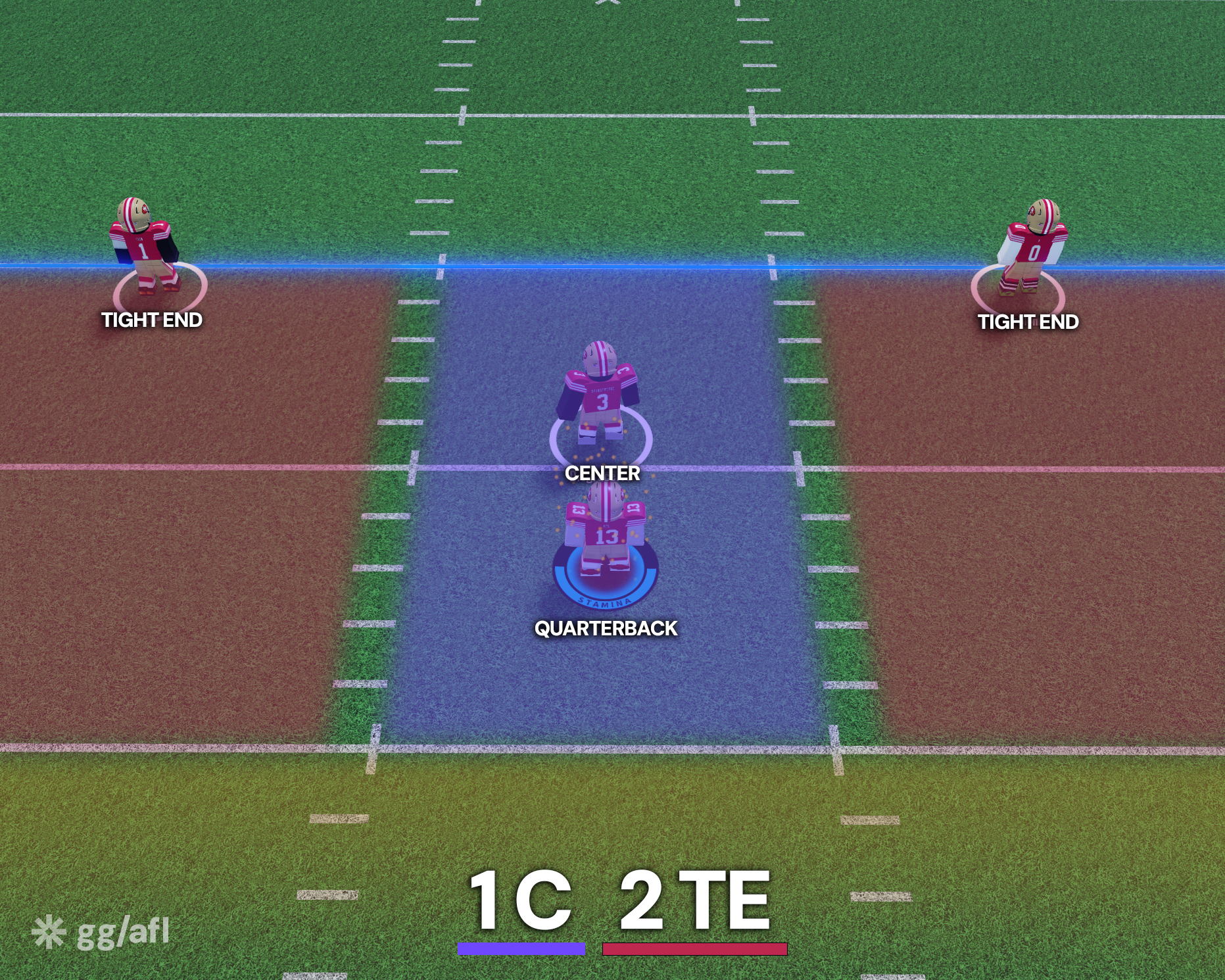
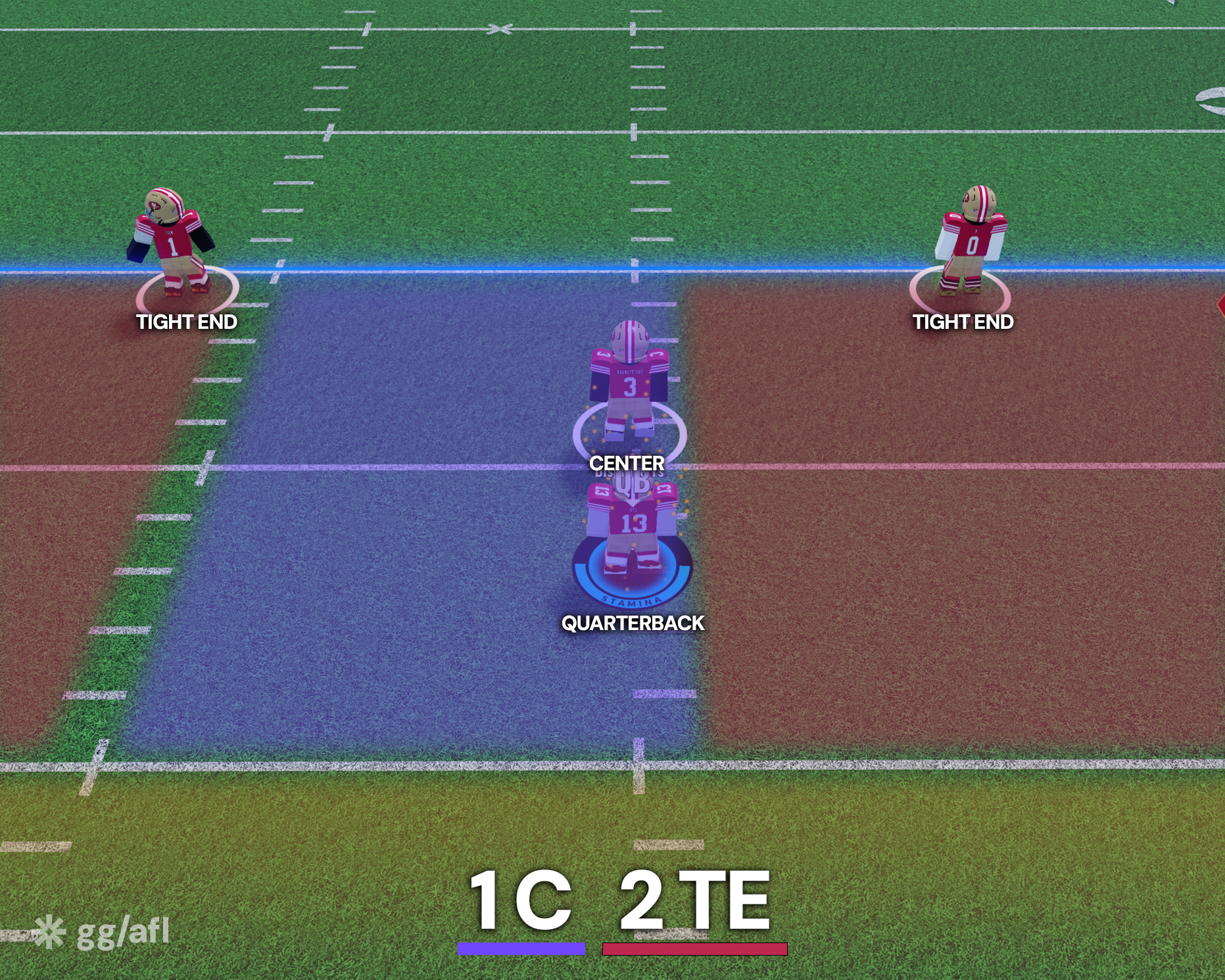
2C · 1TE
The centers must be lined up within the purple zone. 1 on each side of the quarterback. same goes even if the ball is offset.
The tight end must be lined up inside or on the hashes or the red zone and on the line of scrimmage.
The tight end is only able to block up to 5 YDs behind the line of scrimmage. They are not restricted to the red zone when it comes to blocking after snap.
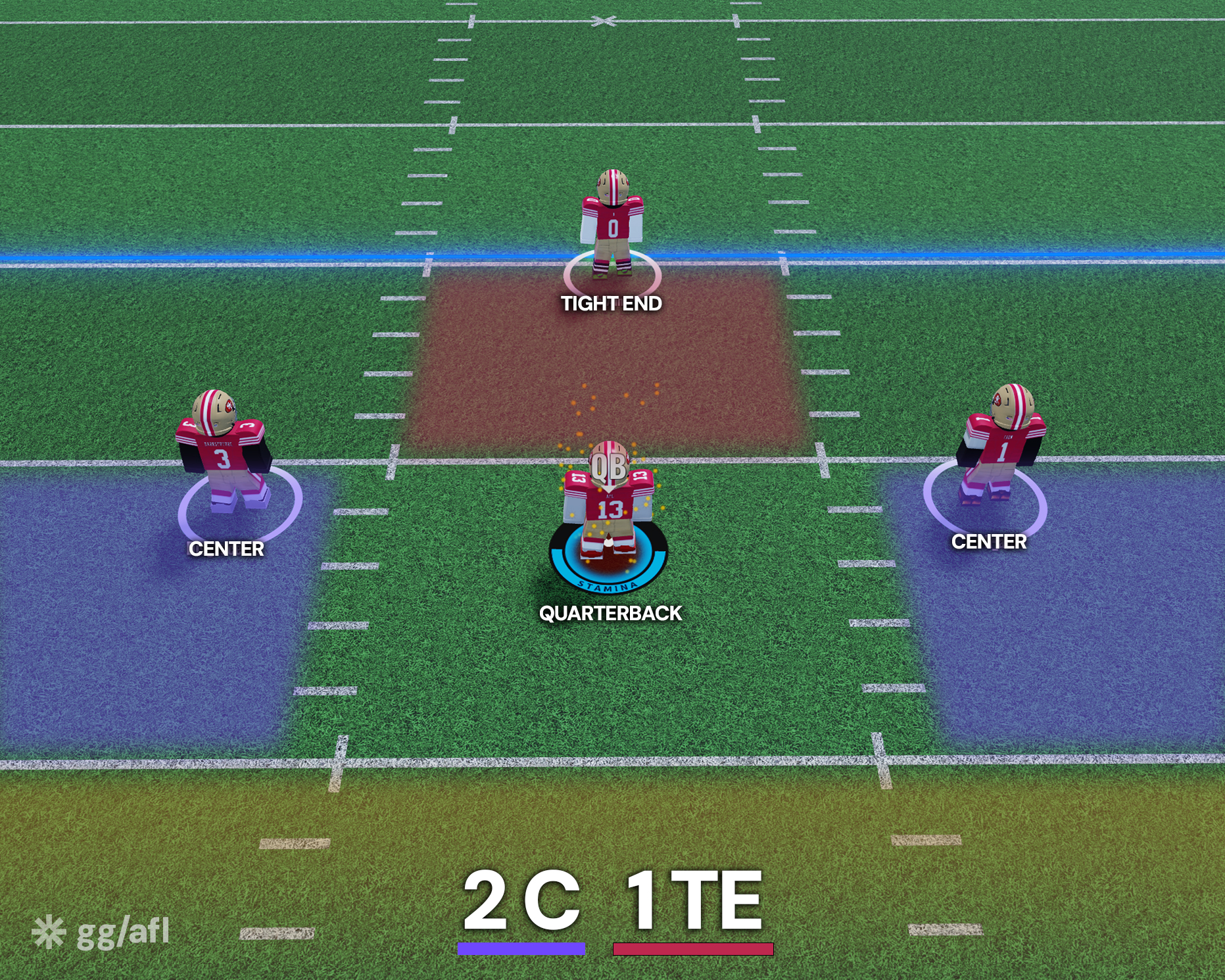
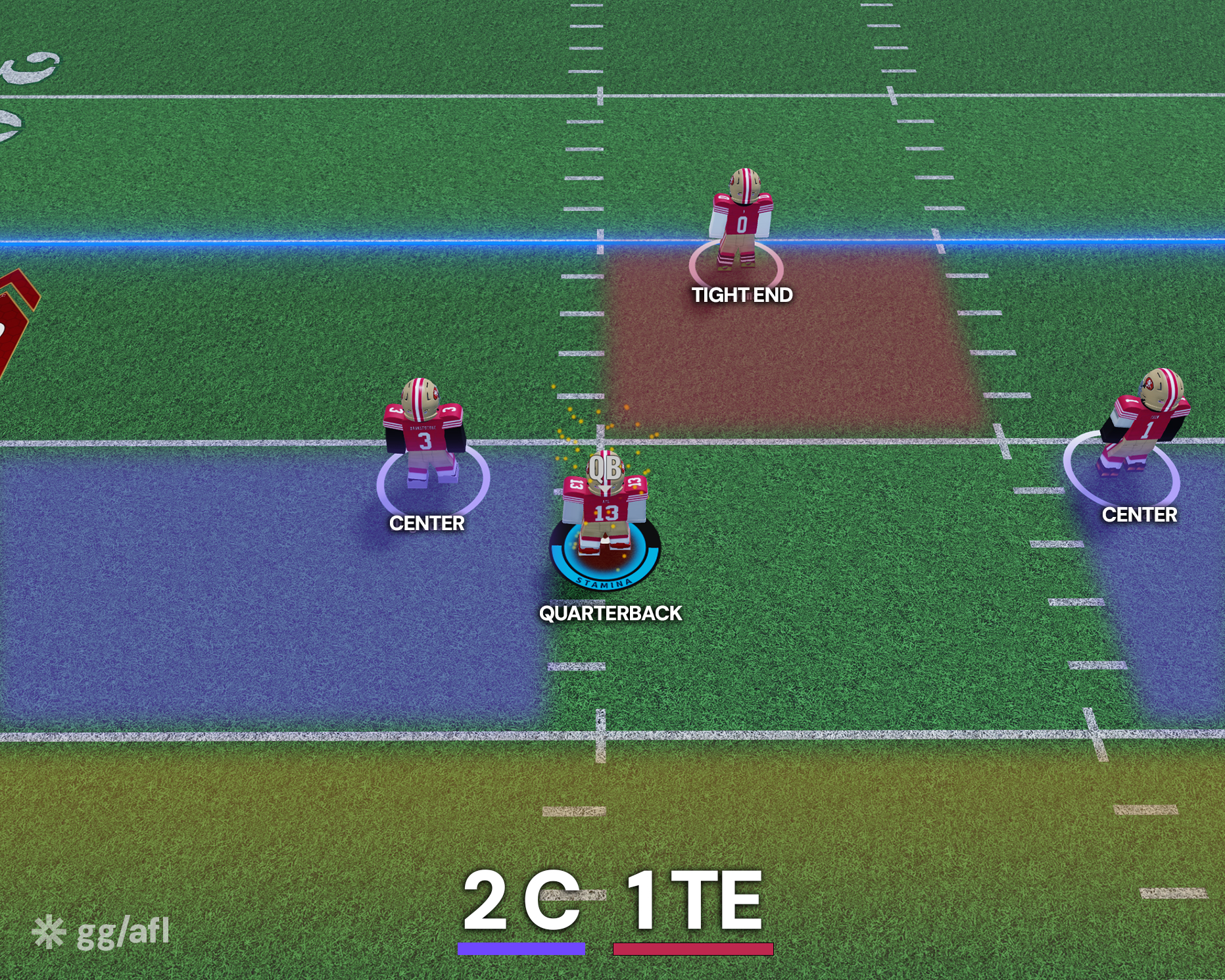
Penalties
It is important to ensure both head coaches are civil about penalties. Both teams are responsible for obeying the rulebook & going by the referee's call.
This occurs when the play clock expires before the ball can be hiked.
This occurs when either the offense or defense has more than 9 players on the field during a play.
This occurs when the receiver steps out of bounds before or after the ball is thrown & catches the pass.
- This also applies to defensive players & will still result in an incomplete play.
This occurs when a defensive end, who is lagging heavily, sacks the quarterback. Ways to determine if a sack was a lag sack, is to see if the defensive end falls down a few moments after the quarterback falls. As well as the distance the player was sacked from. This is a clear sign of a lag sack.
- If called, the defensive end will receive a lag warning. 3 will result in an ejection from the game
This occurs when the quarterback, while in the pocket, throws a pass with no receiver in the area. The ball must land within 15 yards of a eligible receiver.
- If the quarterback is outside of the pocket, a pass just has to be across the line of scrimmage to avoid a grounding call
- While in the air, if the ball crosses out of bounds, that is where the ball will be marked 'down'
This occurs when a receiver or defensive back rides atop of another players' head & catches the ball.
- If called on the offense, will result in a loss of down & ball spotted at the previous spot
- If called on the defense, will result in a spot penalty. Meaning the offense will get the ball where the interception occurred.
This occurs when a player uses the trucking mechanic during a play. Only during the following circumstances is trucking ok:
- Quarterback hands the ball off to a player (Runningback)
- Quarterback throws a backwards pass, allowing the running back to truck.
This occurs when a receiver dives after catching the ball behind the line of scrimmage.
- This applies to all screen / quick passes.
- Does not apply to passes over 20+ yards from distance between quarterback and receiver
Special Teams
The offense is forced to punt or kick a field goal if it is 4th & 7 or longer. This does not apply under 2 minutes in the 2nd or 4th quarter.
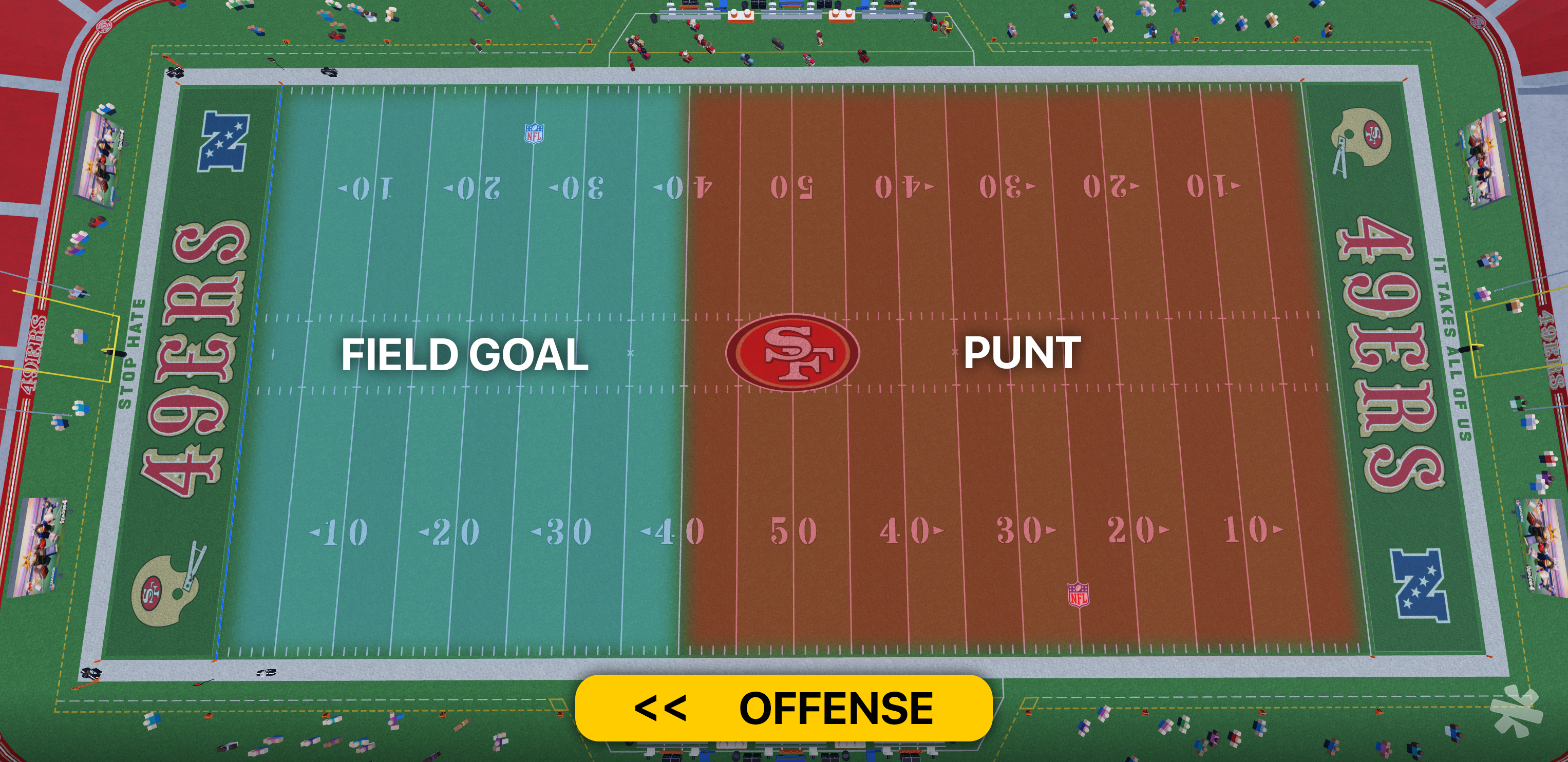
- Teams are not allowed to fake punts or field goals
- Teams may only onside once there is 3 minutes or less left in the game. Must be trailing & cannot onside while tied.
Pin kicks
Teams have the ability to announce pin kicks once per half, allowing the returning team to return the kickoff
- Will proceed as regular kickoff as per the game
- Must announce at least 3 seconds before kick
- Returning team can fumble
Fumbles
There are only specific circumstances where fumbles are allowed to occur:
- Quarterbacks can always fumble.
- Running backs can always fumble on running plays, and passes caught behind the line of scrimmage
- Defensive backs can only fumble if they've crossed the line of scrimmage during an interception return. Or in other cases, interecepting the ball on the opponents' side of the line of scrimmage & fumbling while returning.
- Kick or punt returners can always fumble, including onsides.
- Receiver catching a pass behind the line of scrimmage & fumbling while behind.
Hit Stick
All defensive players are allowed to use the hit stick mechanic.
Milking
Teams are only allowed to waste time (or milk) for certain periods during the game.
- While the clock is running, the offense must hike the ball before the play clock runs under 10 seconds. If unable to, time will be added back to the game clock. This rule is dismissed if there is less than 1 minute remaining in the 2nd or 4th quarter.
- If the quarterback drops back more than 30 yards behind the line of scrimmage, the clock will stop & resume after the following snap.
- If a player gets tackled behind the line of scrimmage, the clock will stop (if in the 2nd or 4th quarter). This rule is dismissed if the offense is trailing.
Overtime
11.1 OVERTIME FORMAT
Overtime shall be conducted using a sudden-death shootout format designed to ensure both teams receive an scoring opportunity.
- Each possession begins at the opponent's 35-yard line
- possessions alernate until a winner is determined
- the team that won the coin toss at the beginning of the game will receive the ball first in overtime
11.2 SCORING RESOLUTION
Overtime scoring follows a "match-or-beat" structure
- If Team A scores and Team B fails to match — game ends
- If Team A doesn't score and Team B scores — game ends
- Once a team outscores the other during their corresponding possession, the game is over
- Teams cannot attempt to kick field goals at any point in this period
11.3 POINT AFTER ATTEMPTS
The availability of point-after conversion attempts changes as overtime progresses:
- OT 1-3: Teams may not attempt a 1-point or 2-point conversion
- OT 4+: Teams may eelect to attempt a 1/2-point conversion; the responding team must match or beat the previous conversion attempt
- example: Team A scores & attempts a 1-point conversion. Team B scores & can decide to extend overtime with a 1-point conversion, or attempt a 2-point conversion and win the game. if Team B fails, the game is over & Team A wins
Mercy rule
If at any point in the game a team leads by 40 or more points, the game will be called final.